- Overview
What Are Helical Piers?
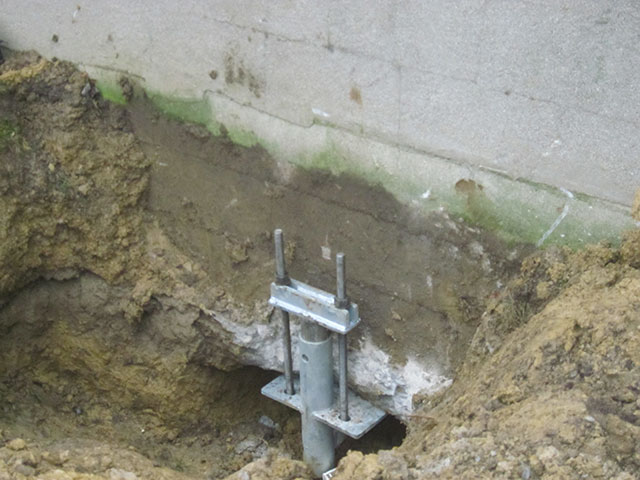
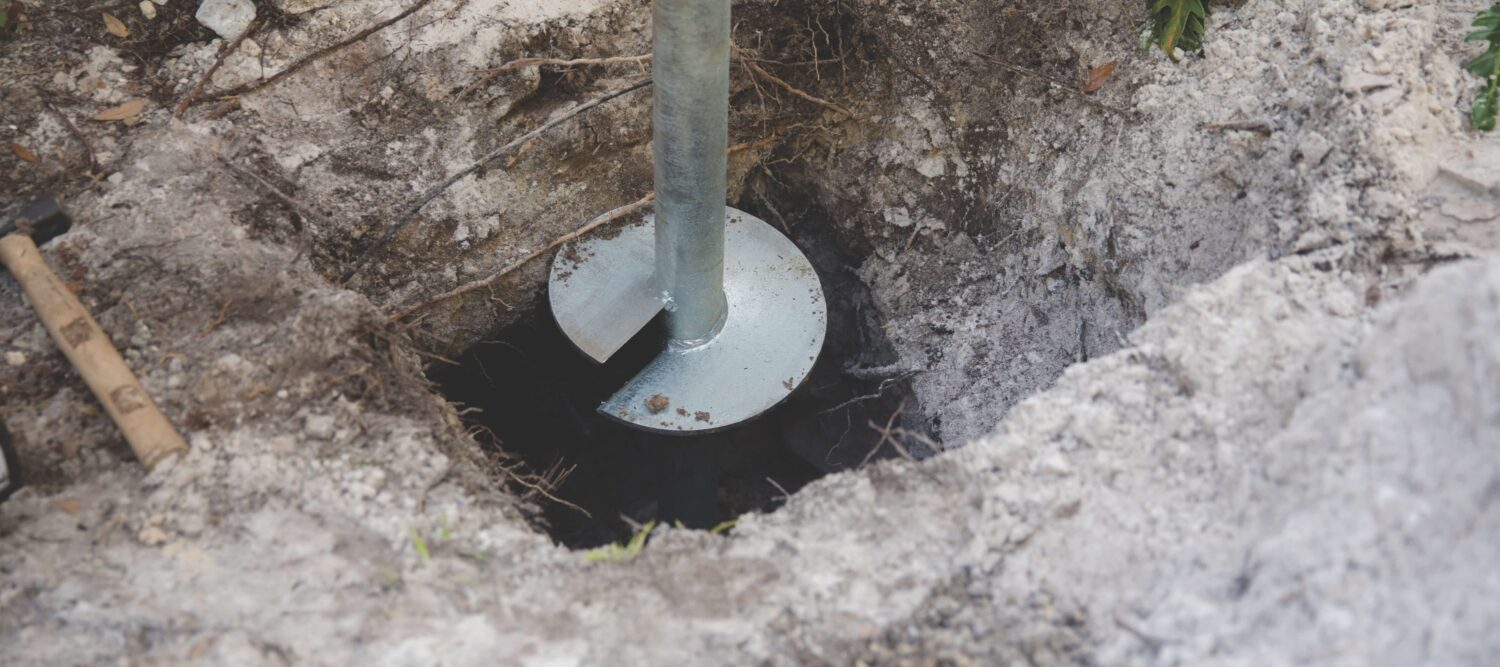
Helical piers — also called helical piles or screw piles — are deep foundation elements that are hydraulically screwed into the ground using specialized installation equipment. Each pier consists of a steel shaft with one or more helical bearing plates welded along its length. As the pier is rotated into the soil the helical plates advance it downward like a screw, transferring structural loads through weak or unstable near-surface soils down to competent load-bearing strata below.
Helical piers can be installed in virtually any soil condition, in tight or restricted access areas, and in all weather conditions. Installation is fast, clean, and quiet — no concrete curing time, no large excavations, and immediate load bearing capacity upon installation.
Shaft Diameter
1.5 inch to 3.5 inch solid square or round
Helix Diameter
6 inch to 16 inch
Typical Depth
10 feet to 100+ feet
Load Capacity
Up to 500+ kips depending on configuration
- How It Works
1
Site Assessment and Engineering
Soil conditions, load requirements, and pier configuration are established. Engineered drawings are produced for the pier layout and connection details.
2
Equipment Setup
Compact installation equipment is positioned at each pier location — operable in basements, narrow yards, and congested sites where larger equipment cannot access.
3
Pier Installation
Each pier is hydraulically rotated into the ground. Installation torque is continuously monitored — torque directly correlates to load capacity so the required bearing capacity is verified in real time.
4
Bracket and Connection
A load transfer bracket is attached at the top of each pier. For foundation repair the structure is connected and hydraulically lifted. For new construction the pile cap or grade beam is connected to the bracket.
5
Restoration
Minor excavation for bracket installation is backfilled and compacted. The small installation footprint means minimal restoration compared to conventional deep foundation methods.
Why Choose Helical Piers
→
Immediate load bearing capacity — no concrete, no cure time, no waiting
→
Installable in restricted access areas — basements, narrow yards, congested sites
→
Real-time capacity verification through torque monitoring — no guesswork
→
Works in all soil conditions and all weather — no concrete placement restrictions
→
Hot-dipped galvanized steel — highly corrosion resistant for long service life
Helical Pier Applications
Foundation Repair
Stabilize and lift settling or failing foundations on existing residential and commercial structures
New Construction
Deep foundation support for new residential, commercial, and industrial construction on poor soils
Utility Support
Support underground pipes, conduits, and utility infrastructure in unstable or settling soils
Retaining Walls
Tieback and anchor support for retaining walls, sheet pile walls, and earth retention systems
Settling Foundation? We Can Help.
Cracked walls, sticking doors, uneven floors, and gaps around windows are all signs of foundation movement. Helical piers can stabilize a settling foundation and, in many cases, restore it to its original elevation — without the cost and disruption of full foundation replacement.
(208) 244-8118
Service 02
Rammed Aggregate Piers
- Overview
What Are Rammed Aggregate Piers?
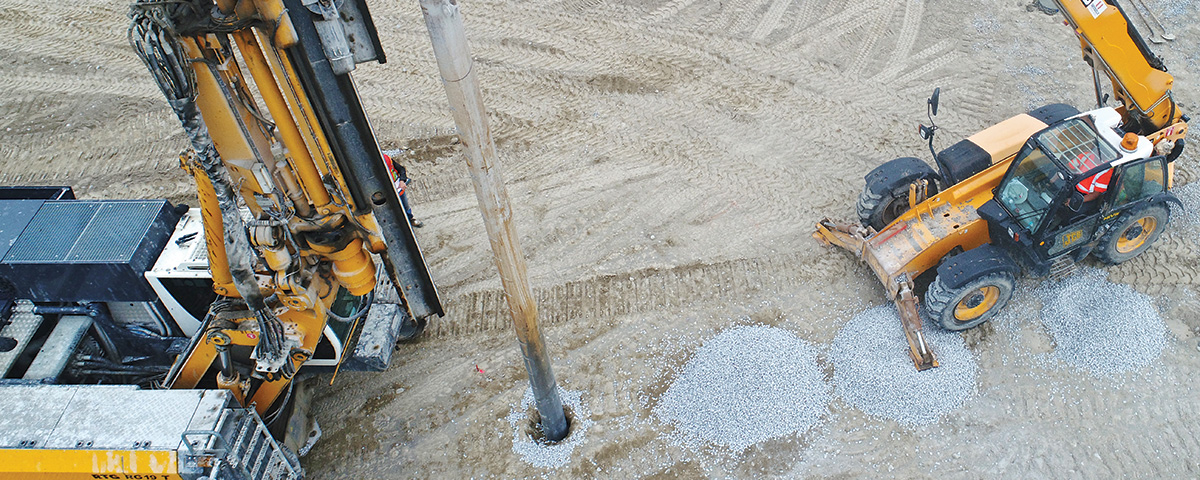
Rammed aggregate piers — also called RAP or Geopier — are a ground improvement method that reinforces weak, soft, or compressible soils to support structural foundations, floor slabs, embankments, and other loads. A steel mandrel is driven or vibrated into the ground to a target depth, then the hole is filled with aggregate in lifts and each lift is rammed with high energy to densify the aggregate and laterally compress the surrounding soil.
The result is a stiff aggregate column surrounded by a zone of densified, improved native soil. The improved soil mass can support significantly higher loads than the untreated soil — allowing foundations to be designed on the improved ground rather than bypassing it with costly deep piles or over-excavation and replacement.
Pier Diameter
18 inch to 36 inch typical
Typical Depth
8 feet to 30 feet
Bearing Improvement
2x to 5x typical
Settlement Reduction
Up to 50% vs untreated soil
1
Geotechnical Review and Design
The project geotechnical report is reviewed and a RAP system designed to meet required bearing capacity and settlement performance. Pier diameter, depth, spacing, and aggregate specs are established by the engineer of record.
2
Layout and Equipment Setup
Pier locations are laid out on the ground surface according to the engineered pier plan. Installation equipment is positioned at the first pier location.
3
Pier Hole Formation
A steel mandrel is driven or vibrated to the target depth. The mandrel displaces and pre-densifies the surrounding soil as it advances — no soil is removed during this phase.
4
Aggregate Placement and Ramming
Aggregate is placed in controlled lifts of 12 to 18 inches. Each lift is rammed with high energy to densify the aggregate and force it laterally into the surrounding soil — building a stiff column with an improved soil zone around it.
5
Top of Pier Preparation
Once the pier reaches design elevation the top is prepared to receive the foundation or load transfer element. A granular working pad or load transfer layer is placed over the pier field before foundation construction begins.
6
Quality Documentation
Installation data — depth, aggregate quantities, ramming energy, and blow counts — is recorded for every pier and provided to the engineer of record for review and project records.
Why Choose Rammed Aggregate Piers
→
More cost-effective than deep foundations in many soil profiles — improves the soil rather than bypassing it
→
No soil removal — displacement method pre-densifies surrounding soil during installation
→
Significantly reduces differential settlement — better long-term performance for slabs and foundations
→
Fast installation — large pier fields completed in days rather than weeks
→
Full installation documentation for every pier — engineer-ready records for project compliance
Rammed Aggregate Pier Applications
Commercial Buildings
Spread footing and mat foundation support for commercial and industrial structures on weak soils
Floor Slabs
Slab-on-grade support in warehouses and industrial facilities on compressible soils
Embankments & Fill
Ground improvement beneath road embankments and approach fills at bridges
Tank Foundations
Settlement control for above-ground storage tanks and large area load applications
Infrastructure Projects
Ground improvement for municipal infrastructure, utility structures, and public works
Residential Subdivisions
Lot-scale ground improvement for residential development on problematic native soils
Which Solution Is Right For Your Project?
Helical piers are ideal when loads need to be transferred to deep competent strata or when working in restricted access areas. Rammed aggregate piers are often more cost-effective when the weak soil layer is within 30 feet of the surface — improving the soil in place rather than bypassing it. JAG Enterprises works with your geotechnical engineer to determine the right solution for your specific soil profile and project requirements.
(208) 244-8118
- Project Photos